 Tromsø Aurora Borealis Tours
Small Group vs Bus Northern Lights Tour in Tromsø
Last reviewed August 2026
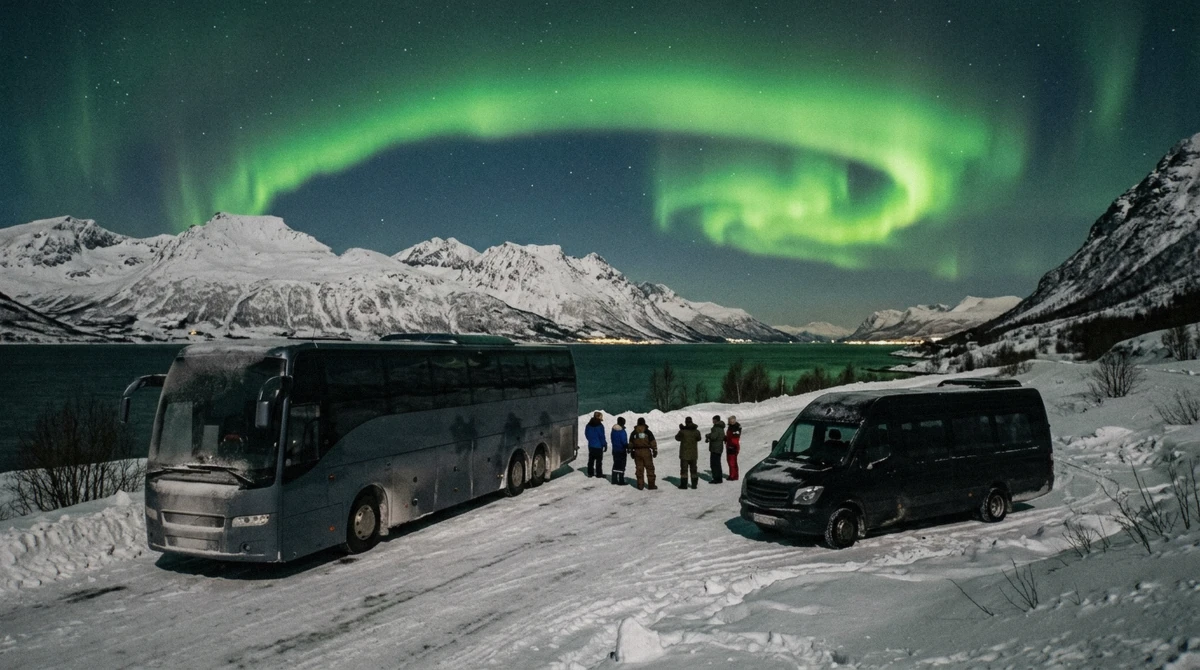
A small group vs bus Northern Lights tour Tromso decision is really three vehicles, not two: a full-size coach, a fifteen-seat minibus, and an eight-seat 4WD minivan. Every listing on Tromso northern lights chases sits in one of those three categories, and the vehicle decides more than legroom. It sets the price, the group cap, whether there is a toilet on board, and which roads the chase can actually reach when the cloud closes in over the main routes. This page reads the terms of all five listings and lines them up by vehicle rather than by name.
Quick answer
The coach wins on price and comfort, with the only toilet on board of the five; the small-group minibuses and the eight-seat minivan win on reaching a clear patch of sky that a bigger vehicle cannot get to. Neither is right for every traveller. See the exact numbers in the vehicle and group-size table on the homepage before picking a side.
Key takeaways
- The full-size coach is the cheapest seat on the page and the only vehicle with an onboard toilet
- Two minibuses cap at 15 travellers; one states no cap at all
- The eight-seat 4WD minivan is the smallest group on the page and reaches roads none of the others can
- One operator claims its minibus has a higher success rate than a big bus at chasing the lights, a claim nobody on this page has published data to back
- Group size changes loading speed and elbow room, not the sky itself
- What the price difference buys is worth reading before paying triple for a smaller seat count
At a Glance
Coach, minibus, minivan, side by side
Five listings, three vehicle types. The numbers below come straight from the listings themselves, read in August 2026.
| Vehicle | Price from | Group cap | Toilet | Gear | Flexibility |
|---|---|---|---|---|---|
| Full-size coach (Jeshua As) | $59 | None stated | On board | Rental extra, reserve in advance | Main roads and larger pull-offs |
| Minibus (Arctic Breeze, Northern Horizon, Chasing Lights) | $133 to $258.30 | None stated to 15 | Stops only | Included, or included once sizes are sent | Reaches side roads a coach cannot take |
| 8-seat 4WD minivan (Greenlander) | $351.93 | 8 | Stops only | Included once sizes are sent | Reaches remote tracks a minibus cannot, unloads fastest at a gap |
Directly below
Compare the full-size coach against the eight-seat 4WD minivan at opposite ends of the price ladder, or read the middle ground on the adults-only premium minibus.
What the Coach Gives You
The cheapest seat, and the only toilet
Jeshua As runs the sole coach on this page, and at $59 it is the cheapest fare of the five by a wide margin. It is also the only vehicle here that carries a toilet on board, which matters more than it sounds on a tour that can run past six hours with stops made on unlit road shoulders.
The trade-off is flexibility. A full-size coach needs a proper pull-off to stop safely and cannot follow the narrower side roads a smaller vehicle uses to slip around cloud. It restricts the chase to main roads and the larger, prepared stopping points along them, which is a reasonable trade at this price but a real one.
What is not included
No pickup is offered on this listing at all, and the thermal suit and boots are separate rentals rather than part of the fare, with advance reservation recommended for the suit. Add both of those costs before comparing this fare directly against a minibus that includes gear outright.
What Changes in a Minibus
Three different minibuses, three different caps
Arctic Breeze states no group cap on its minibus. Northern Horizon's premium seat is adults only and capped at 15, while the classic seat on that same listing actually rides in a coach rather than a minibus, which is easy to miss since both sit under one product page. Chasing Lights caps its minibus at 15 as well, with a minimum of 8 participants required for the trip to run at all.
What all three share is a smaller vehicle than the coach, which means faster loading when a gap opens in the cloud and access to roads a full-size bus has to skip.
The claim worth reading carefully
Arctic Breeze argues directly on its own listing that a minibus is more flexible and has a higher success rate at chasing the lights than a big bus. That is the operator's own claim, not an independently measured figure, and no listing compared on this page publishes an audited sighting rate of any kind. Treat it as a reasonable argument about manoeuvrability, not as a statistic.
The two-person crew on one listing
Chasing Lights runs its minibus with a dedicated driver separate from the photographer guide, which frees the guide to shoot and coach travellers on camera settings while someone else focuses entirely on the road and the forecast. That split-role setup is unique to this listing among the five compared here.
The Eight-Seat Extreme
The smallest group on the page
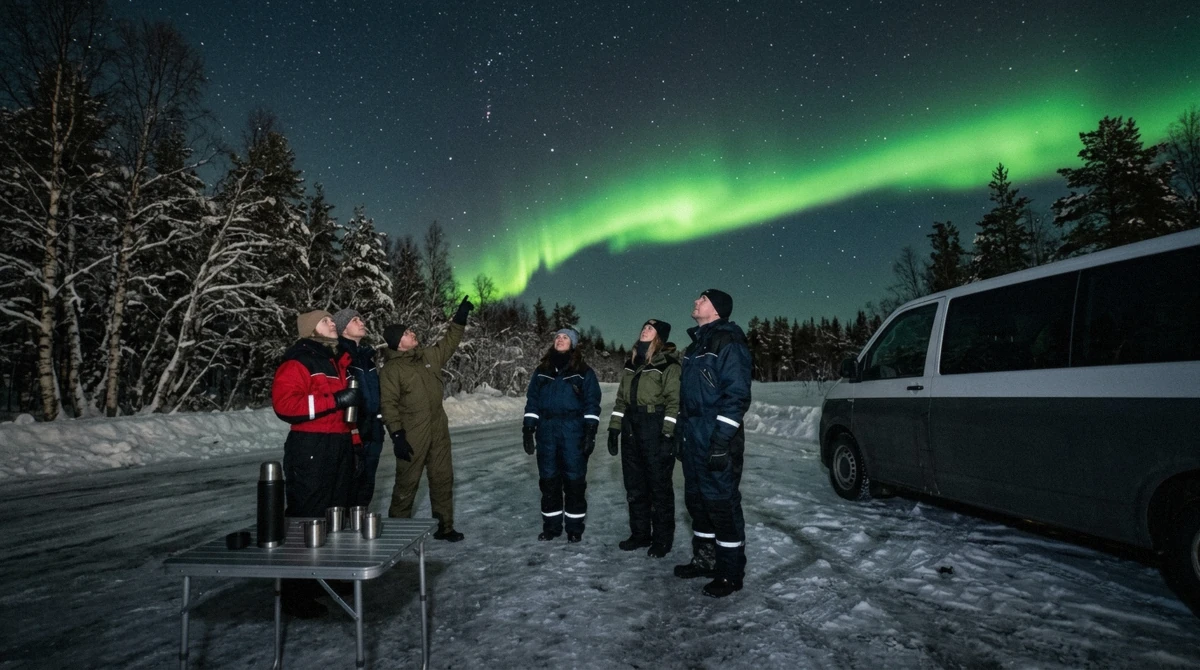
Greenlander's chase uses a modified 4WD Mercedes-Benz minivan capped at 8 travellers, the smallest group of the five by a clear margin. The operator sells that capacity directly as access: a 4WD reaches remote parts of the landscape that neither the coach nor the standard minibuses can follow, and it can unload and reposition faster than a fifteen-seat vehicle at a brief gap in the cloud.
That access comes at the highest price on the page, $351.93, and with the strictest terms: the fare is non-refundable and there is no reserve-now-pay-later option, unlike every other listing compared here.
What the small group actually buys on the night
In practice the eight-seat cap means more of the guide's attention per traveller, quicker boarding at a roadside stop, and a genuine chance of reaching a side track that a fifteen-seat minibus would have to pass by. It does not mean a stronger sky. The vehicle changes how efficiently the group chases a gap; it does not change whether a gap exists that night.
Does Group Size Change Your Odds?
No published number, on either side
Operators argue their case in both directions, and none backs it with a measured figure. Smaller-vehicle operators argue manoeuvrability; larger-vehicle operators simply do not make the claim at all. No operator compared on this page publishes an audited success rate, and that absence should be read as informative in itself: if a genuinely reliable advantage existed and could be proven, it would be the headline of the listing rather than a passing line in the terms.
The review that undercuts the small-group argument
A two-star review on the Chasing Lights minibus, a 15-seat vehicle, describes a night spent settled in one place for roughly six hours around a small campfire, with what the traveller called a distinct lack of chase or urgency to move. That is a direct counterexample to the idea that a smaller cap automatically buys a more active chase: the vehicle can move quickly, but whether it actually does depends on the guide's decisions that night, not the seat count printed on the listing.
The honest takeaway is that group size buys logistics, loading speed, road access, elbow room, not a guaranteed style of night. A guide willing to keep driving matters more than the cap on the door.
What actually correlates with a better night
Reading across the reviews on all five listings, the pattern that repeats is not vehicle size, it is willingness to drive. The tours reviewers praise most, on both large and small vehicles, are the ones where the guide kept relocating after a blank stop rather than settling in for the evening. The tours that draw the lowest ratings, again on both large and small vehicles, are the ones where the group parked once and waited.
Group size affects how fast that relocation happens once the decision is made, not whether the decision gets made at all. A fifteen-seat minibus with a guide who keeps chasing will outperform an eight-seat minivan that settles early, and the reverse is just as true. Judge the operator's stated approach to routing, covered on the individual tour pages, before judging the seat count on the door.
What you gain and what you give up, per vehicle
The at-a-glance table above lists what each vehicle has. This one lists what it costs you, which is the column no operator prints on its own page.
| Vehicle | What you gain | What you give up |
|---|---|---|
| Full-size coach, $59 | The cheapest seat out of the city by a wide margin, a heated cabin for a long drive and the only toilet on board | Side roads and small pull-offs, fast loading at a brief gap in the cloud, and the thermal suit, which is a separate rental with no published price |
| Minibus, $133 to $258.30 | Routes a coach cannot take, gear included in the fare, and on one listing a dedicated driver so the guide can stay at the tripod | A toilet on board, and on one listing the trip only runs if eight people book it |
| 8-seat 4WD minivan, $351.93 | The smallest group in town, tracks no other vehicle here can reach, dinner rather than snacks and transfers both ways | Roughly six times the coach fare, any refund at all, and the option to reserve now and pay later |
Who Should Book Which
If You want the lowest price and don't mind a fixed route
The full-size coach, and budget for the suit rental on top of the $59 fare
If You want gear included without extra forms and a reasonably sized group
A minibus with no stated cap or a straightforward inclusion policy, over one that requires submitting sizes after booking
If You are travelling with young children in deep cold
A listing with no age restriction and clothing included outright, checked in advance, rather than one gated behind a sizes form
If You want the smallest group and remote road access, and can accept no refund
The eight-seat 4WD minivan, booked only once your dates are certain
If You want an adults-only, quieter minibus with a campfire stop
The premium small-group seat, understanding the classic option on the same listing actually rides a coach
What We Would Book
The honest read on the evidence here
For most travellers, especially a couple or a small group without children, the coach at $59 is the rational starting point: it is the cheapest way to see the same sky, and the toilet on board is a genuine comfort advantage on a six-to-nine-hour night. The suit rental narrows the gap to a minibus fare somewhat, but the coach still wins on price for anyone who already owns proper winter layers.
The case for paying more sits specifically with travellers who value road access and a smaller group over cost: a party chasing the best possible odds on a single, non-negotiable night, or a group that wants the guide's attention undivided across fewer seats. That is a real, defensible reason to book the eight-seat minivan or a smaller minibus. It is a weaker reason to do it purely on the operator's own claim of a higher success rate, since that claim has no published number behind it anywhere on this page.
Vehicle and Group Size Questions
How many people are typically on a Tromsø aurora bus?
It varies by listing. Two minibuses on this page cap at 15 travellers, the coach and one minibus state no cap at all, and the smallest vehicle, an 8-seat 4WD minivan, caps well below the rest.
Which vehicles have a toilet on board?
Only the full-size coach does. Every minibus and the 4WD minivan on this page stop at roadside points where nature has to do, in the wording one listing uses directly.
Does a smaller group actually improve your chances of seeing the lights?
No operator compared here publishes an audited figure either way. A smaller vehicle loads and repositions faster, which can matter at a brief gap in the cloud, but a documented two-star review on a 15-seat minibus describes six hours parked in one place with little urgency to move, showing that vehicle size alone does not guarantee an active chase.
What is the real price gap between a coach and the smallest minivan?
The full-size coach starts at $59; the eight-seat 4WD minivan runs $351.93. That is close to six times the coach fare for a cap of 8 rather than an unstated capacity, plus remote-road access the coach cannot match.
Which option suits travelling with children?
It depends on the listing rather than the vehicle type. Some set no minimum age but require clothing sizes submitted in advance; one minibus is adults only outright. Checking the age policy and gear-inclusion terms on the specific listing matters more here than choosing by vehicle size alone.
Do smaller groups get more time at each stop?
Loading and unloading is faster with fewer seats, which can add a few working minutes at a brief clearing in the cloud. How long the group actually stays at a stop is a guide decision on the night, not a fixed feature of the vehicle.